Well, there are more factors indeed, the things I said are very simplified, and most stuff I said is about tirepressure, i.o.w. tire shape.
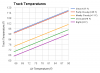
The other factor involved when it comes to tire temperatures is the actual rubber compound, which has it's own optimal temperature. this would be lower for road tires, and higher for racing tires ofcourse, but it also has a fall off at both sides of the range.
Cold rubber becomes harder, less grippy and more prone to wear because of the loss of flexibility combined with the loss of grip. ( compare it to a sander on hard wood will take material off, but the same sander on your softer hand won't, at least, not as fast) Hot rubber becomes 'greasy', in other words it becomes so soft it loses structural integrity, and instead of material 'sanding off', it gets rubbed off.
Of course you want the optimal temperature for tire shape and rubber compound to be the same, but as said before, track etc is also of influence. You can however assume that driving 'hard' is not advisable, as the choice of compound is usually done in such a way that it assumes you will drive on the edge of grip as noodle said, but not over the edge of grip (driving hard).
Same goes for braking. Hot brakes will up your tire temperature, so eventhough sharp braking and sudden release of brakes may win time in the short run, the upped tire temperatures will lead to more tire wear in the long run, so it's better to do less sharp braking and more gradual release of the brakes.
Rough driving style is bad for tires, though you can compensate high tire temperatures with lower starting pressure when it comes to tire shape, but it won't help for your rubber compound optimum temperature.
Humidity is a tough one, but in general it magnifies temperature effects. Humid cool air will cool stuff faster, but humid warm air will warm things faster then the not humid variants.
Then tire profile depth complicates things even more. The deeper the profile, the more negative the hot effect becomes. As the rubber becomes softer, the rubber 'blocks (iow the area between the profile) bends more, so a bending block on the road is laterally offset compared to the next block that will touch the road, causing the tires to 'sidestep' even when still having full grip. That's why, next to contact surfacearea, you don't want to use rain tires on the dry.